Augmented Glass
Transparent, bezel-free handheld displays for mobile AR, prototyped in 2011 with back-projected glass and Meccano.
- Company
- HP / Palm
- Year
- 2011
- Role
- Concept and prototypes · interaction design, ergonomics and usability exploration
- Team
- Future Concepts and Prototyping team, HP/Palm R&D Center
- Location
- Sunnyvale, CA
Technology
- Back-projection coated glass
- Pico projector
- Dual cameras (environment and face)
- View-dependent rendering
- Keystone correction
01The opportunity
Science fiction had been showing transparent handheld displays for years. In 2011, with tablets taking off, we wanted to know what such a device would actually be like to hold and use, and whether it could be a new product category beyond the tablet.
02The idea
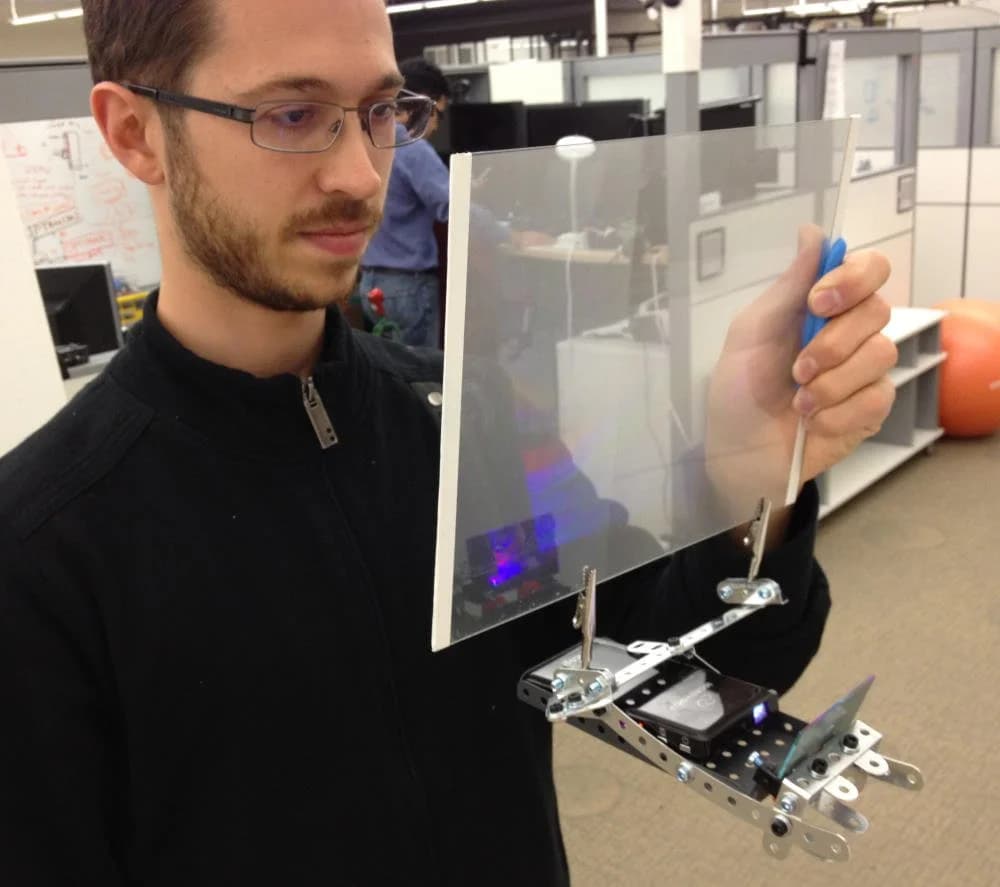
A thin, transparent handheld display with minimal bezel for immersive mobile AR. A forward camera captures the environment; a user-facing camera tracks the face for view-dependent rendering, so the content lines up with the world behind the glass. The project explored practical solutions for holding and interacting with something this thin and transparent.
03My role
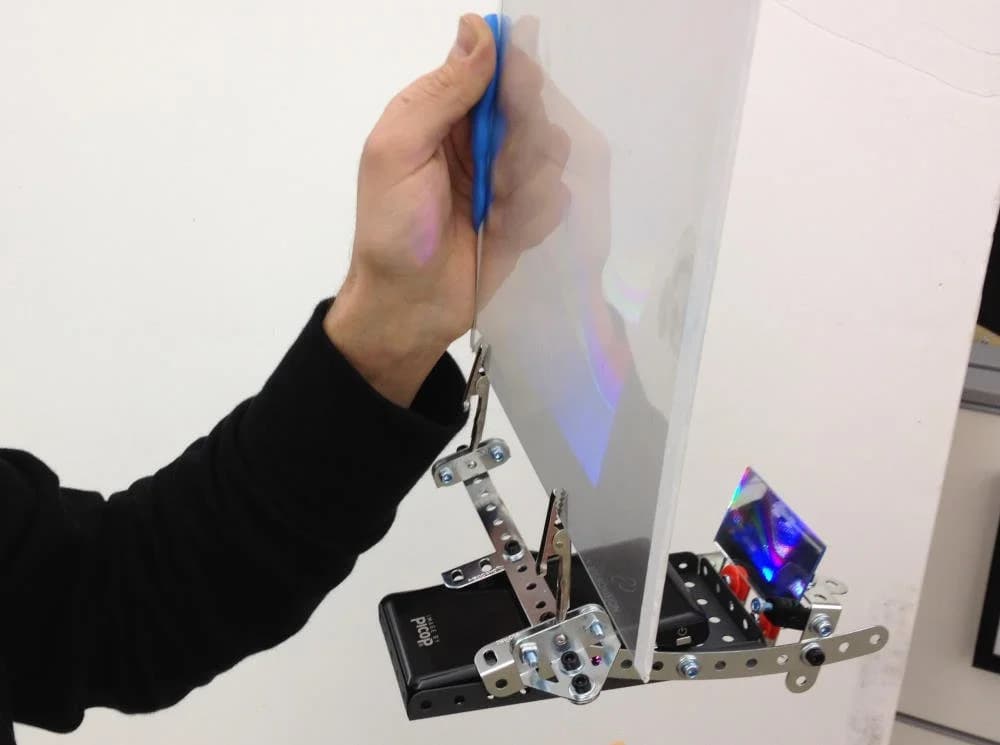
I built the early prototypes from Meccano parts to test and refine the concept quickly, then the coated glass panels and pico-projector rig, and used them to explore interaction design, ergonomics and usability for optical see-through devices. Keystone correction was implemented later. The work was completed in November 2011.
04How it worked
Tablet-sized glass panels are coated for back-projection and lit by a portable pico projector. Two cameras complete the system: one facing forward to capture the surroundings, one facing the user for facial tracking and view-dependent rendering.
05Prototype / product
06Outcome
A set of working prototypes and a clear understanding of the interaction, ergonomic and optical constraints of transparent handheld displays, completed in November 2011 as a step toward redefining the tablet.
- Working prototypes, November 2011