Nudging Headphones
Headphones that gently push or pull your head in a direction, opening a third channel to the user that is neither visual nor auditory.
- Company
- HARMAN International
- Year
- 2014 — 2016
- Role
- Concept, prototype program and patenting across three actuation methods
- Team
- Future Experience Team
- Location
- Palo Alto, CA
Technology
- Center-of-gravity shifting (mechanical / pneumatic)
- Asymmetric linear acceleration
- Ducted fans and MEMS propulsion
- Vestibular perception
- Rapid physical prototyping
01The opportunity
Wearables talk to us through screens, sounds and vibration. For navigation, directional warnings and immersive experiences, all three are either occupied or too crude. We asked whether a device on the head could create the sensation of being pushed or pulled in a direction, subtle enough to feel almost subconscious.
02The idea
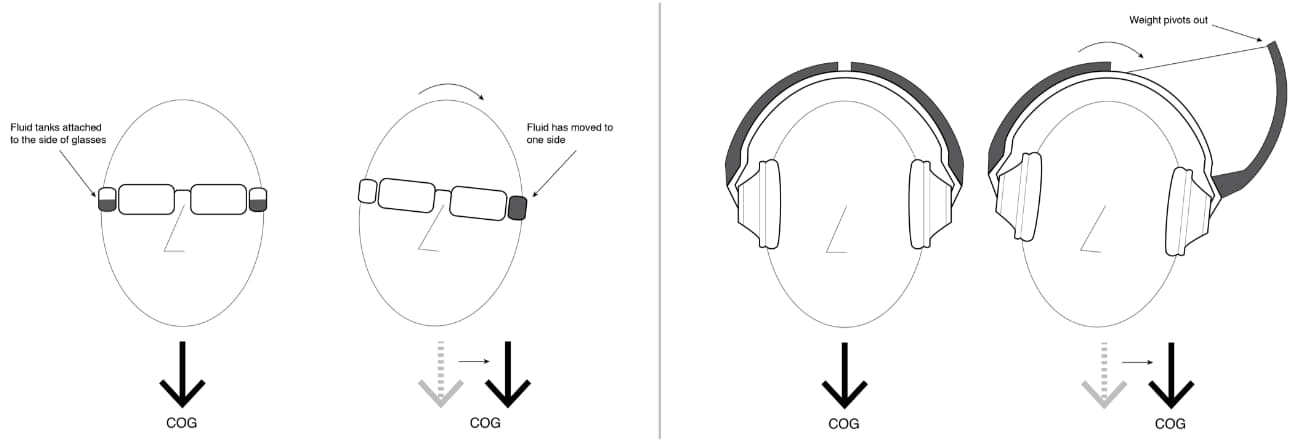
Ungrounded force feedback on the head. A small imbalance or a brief directional force is perceived through the vestibular system and prompts the user to turn toward it, without a visual or auditory signal. Applications: pedestrian navigation, directional alerts to danger or points of interest, virtual assistants that direct attention quietly, gaming and AR/VR/XR. Suitable for headphones, hearables and head-mounted devices.
03My role
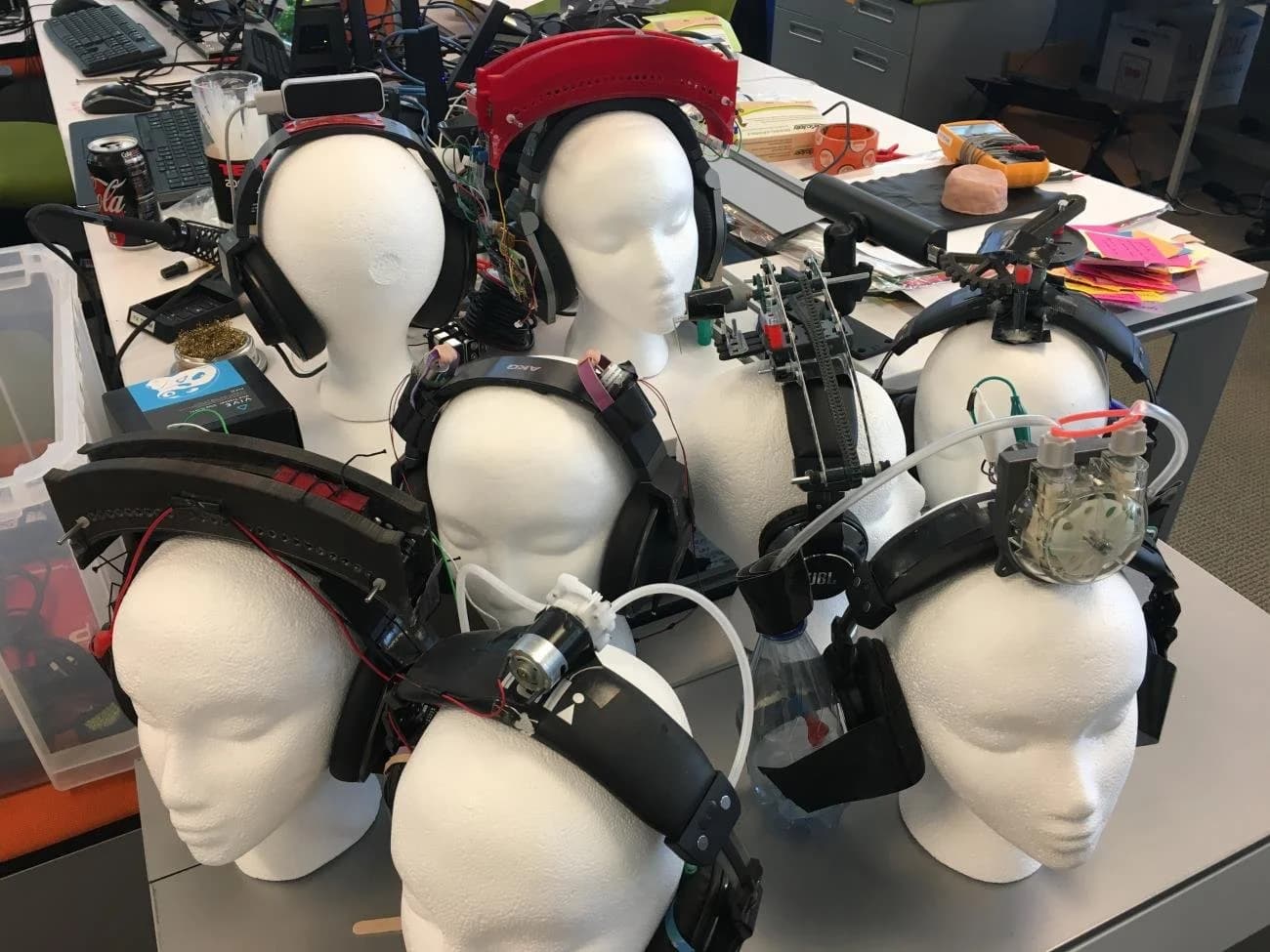
I drove the concept and the prototype program and worked on the patents for all three methods. Because these sensations are almost impossible to describe or simulate, we built the prototypes quickly and exaggerated them for clarity, so the effect could be experienced directly and then miniaturized.
04How it worked
We developed and tested three distinct methods for creating the sensation.
- Dynamic weight shifting
- Mechanically or pneumatically moving the center of gravity, by redistributing fluid between small containers or moving weights along rails or hinges. Straightforward, effective and suitable for productization.
- Linear asymmetric acceleration
- Small masses on parallel rails accelerate sharply in the desired direction and return slowly, below perception thresholds. Multiple masses run out of phase so the user feels a continuous push or pull in one direction, without vibration or intermittent poking. Extraordinary sensation, complex mechanics.
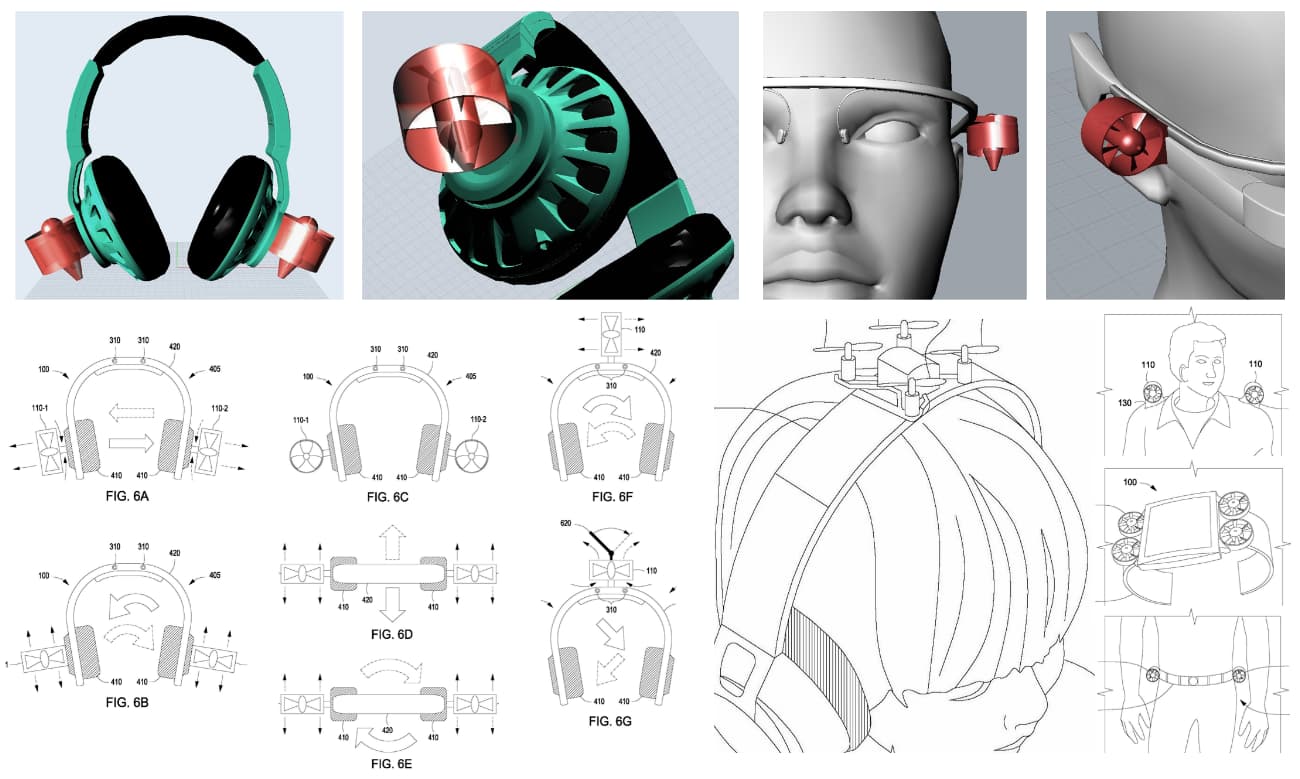
- Miniaturized air propulsion
- Ducted fans, micro turbines, MEMS propulsion or compressed-air micro jets create airflow that nudges the head. Designs include panning fans, thrust-vectoring vanes, and a quadcopter-like assembly with four degrees of freedom. The patent also covers thermal and noise management, including active noise cancellation for the fans.
05Prototype / product
06Outcome
All three methods were patented. Two patents were granted, the fan-driven force device and the pseudo force device, and the center-of-gravity shifting device was granted in Europe. The underlying perceptual principles are documented in the scientific literature referenced in the patents.
- Three actuation methods prototyped
- Three patent families
07Patents, press, links
Patents
- US 9984540 B2Fan-driven force device2018
- US 10296018 B2Pseudo force device2019
- EP 3254121 B1Center of gravity shifting force device2019